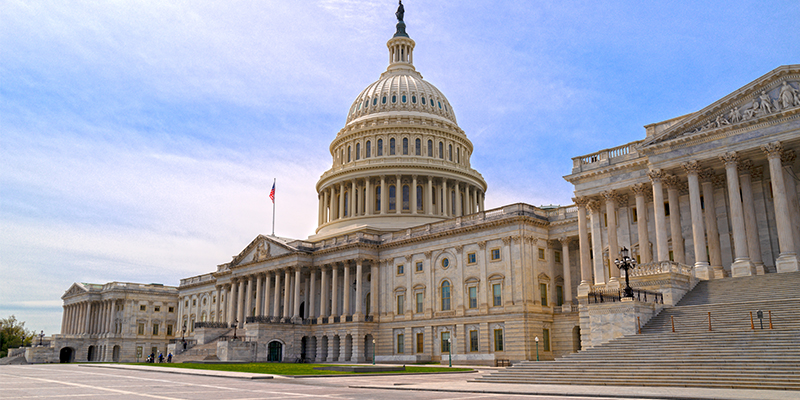
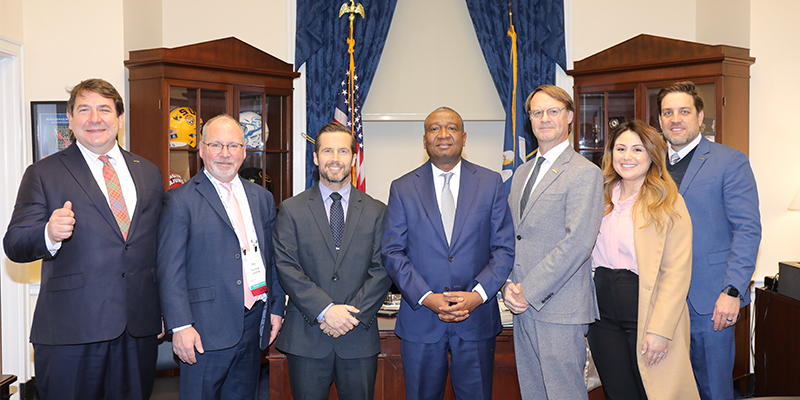
Last week, NAIOP members from chapters across North America came to Washington, D.C., to participate in the 2026 Chapter Leadership & Legislative Retreat. The event capped off on Wednesday with NAIOP’s Capitol Hill Day, when NAIOP members and chapter local executives met with Senate and House members and their staff.
Getting to know your elected officials is an essential element in promoting public policies that make commercial real estate successful. As former Speaker of the House Thomas Phillip “Tip” O’Neill Jr. famously said, “All politics are local,” and the purpose of these meetings was not only to educate policymakers on NAIOP’s national priority federal issues, but to also introduce NAIOP members and inform members of Congress of the contributions that they are making to their states’ economies.
Lobbying Congress is a right that you are guaranteed under the First Amendment to the Constitution: “Congress shall make no law respecting an establishment of religion or prohibiting the free exercise thereof; or abridging the freedom of speech, or of the press; or the right of the people peaceably to assemble, and to petition the government for a redress of grievances.”
Lobbying is essentially developing a professional relationship with your elected officials, and through those relationships educating them on how legislation and regulations influence your business decisions and affect economic activity.
NAIOP’s Capitol Hill Day should serve as the beginning of your efforts to meet your senators and representatives, and your NAIOP chapter offers many opportunities for you to continue to develop those relationships. Inviting your elected officials to attend your chapter events is a great way to connect them to the broader NAIOP membership. Your senators and representatives should also be invited to tour projects and learn about how your buildings create jobs and housing opportunities for the people that they represent. The work that NAIOP members do improves the quality of life in your community and you need to continue to tell that story.
This year, NAIOP members are focused on three priority issues:
Adaptive reuse incentives and housing affordability. NAIOP members probably recognize this as a topic on which we engaged with Congress over the last couple of years as office vacancy rates persist in the aftermath of the COVID-19 pandemic and the related increase in work-from-home patterns. While many companies are implementing return-to-office policies, the impact on many Class B and C buildings in terms of reduced occupancy is persisting, with demand largely shifting to Class A trophy buildings. At the same time, the availability of affordable rental housing has been worsening over the last few years.
To help remedy this situation, NAIOP has been working with Representatives Mike Carey (R-OH) and Jimmy Gomez (D-CA) on promoting the Revitalizing Downtowns and Main Streets Act (H.R. 2410). This legislation would incentivize the adaptive reuse of vacant and underutilized commercial buildings for residential purposes. The bill creates a tax incentive to offset 20% of the eligible conversion costs resulting from adapting an underutilized commercial building (office, industrial or retail) into housing, a certain component of which would be dedicated to affordable housing. Enactment of a conversion tax credit would give localities an added tool to increase the supply of affordable rental housing while reducing the probability that many outdated or noncompetitive commercial structures will become stranded assets. In their Hill meetings, NAIOP members provided officials and their staff with an“Adaptive Reuse and Housing Affordability” one-pager.
Meeting the increased demand for electricity. Throughout 2025, NAIOP’s advocacy team met with federal officials to highlight our concern over the future availability of electricity to power both the growth in the use of artificial intelligence and needed commercial real estate development. Consumers are already experiencing increasing utility prices and the projected growth in energy demands, from building electrification, data centers and consumer consumption over the next decade will require policymakers to take action.
NAIOP is encouraging Congress to pursue comprehensive energy policies designed to meet electricity demand throughout the U.S. economy. These measures will require increased investment in electrical grid expansion and modernization, and permitting reforms for energy production and transmission projects. In their Hill visits, NAIOP members shared with officials and their staff an “Electrification and Energy Policy” one-pager.
Transportation and infrastructure funding. Modern and efficient transportation systems are essential for our states and localities and are a key ingredient for vibrant commercial real estate markets. The current five-year authorization for federal surface transportation programs expires on Sept. 30, 2026. NAIOP supports the passage of a multiyear transportation reauthorization before the September deadline to ensure that local governments have the funding certainty needed to undertake the planning and development of major projects. Realistic funding levels reflecting the impact of inflation, the increased number of electric vehicles, and other relevant factors must be considered to ensure a forward-looking surface transportation reauthorization. In their Hill visits, NAIOP members provided officials and their staff with a “Transportation and Infrastructure” one-pager.
NAIOP’s federal advocacy efforts are most effective when we work with our members to educate federal legislators and their staff on how the policies that come out of Washington influence economic activity at home. The midterm elections in November offer an opportunity for NAIOP chapters to sponsor candidate forums and/or invite elected officials and candidates to speak at chapter events. NAIOP members are the business leaders of their communities and the projects they build contribute to their local economies. During my time as a congressional staffer, we were regularly looking for opportunities to meet with constituents and NAIOP members were just the type of people that we wanted to meet.