
Tucked inside a former furniture store in Los Angeles sits one of the most sophisticated food production facilities you’ve likely never heard of. Owned by City Storage Systems and operated by ProFood Properties, this 30,000-square-foot “cloud kitchen” is a case study in how real estate, engineering and food technology converge to power the modern delivery economy.
A small group of attendees at NAIOP’s I.CON West this week in Los Angeles had the opportunity to explore a facility located at 114 Sunset Boulevard in the Echo Park neighborhood, a quarter mile from Dodgers Stadium.
When City Storage Systems acquired the building, it was a traditional retail box. Since 2022, it has housed 27 fully built commercial kitchens under one roof. Built out on two floors; narrow hallways; shared ambient, cold and freezer spaces; and kitchen spaces roughly 200 square feet in size have been strategically situated.
“Our whole goal is to maximize useful space and kitchen space,” said Jason Jaffe, senior director with City Storage Systems. “And that’s by design.”
Jaffe said that in a traditional 8,000-square-foot restaurant, perhaps 2,000 square feet is kitchen. Here, the entire building is essentially kitchen infrastructure – multiplied. “The most difficult part to build in any restaurant isn’t the dining room, it’s the kitchen. And we replicated that 27 times under this roof.”
The challenges: massive gas capacity, huge plumbing capacity, enormous heat that has to be exhausted – and cold air that has to come back in.
“The Biggest Company You’ve Never Heard Of”
City Storage Systems operates globally, though it deliberately keeps a low public profile. The company currently controls more than 5.1 million square feet globally, with facilities spanning the U.S., Canada, Latin America, Europe, the Middle East and Asia.
Within its portfolio, two real estate divisions focus exclusively on food infrastructure strategy:
- Cloud Kitchens – Multitenant last-mile food production facilities, including the facility toured in Los Angeles.
- ProFoods Properties – Large, single-tenant, purpose-built food production and processing facilities upstream in the supply chain.
Built for Last-mile Delivery
This specific Los Angeles facility is focused on last-mile food delivery – meaning food prepared here goes directly to consumers, often within minutes. Operating around the clock, this facility powers order fulfillment at an industrial scale.
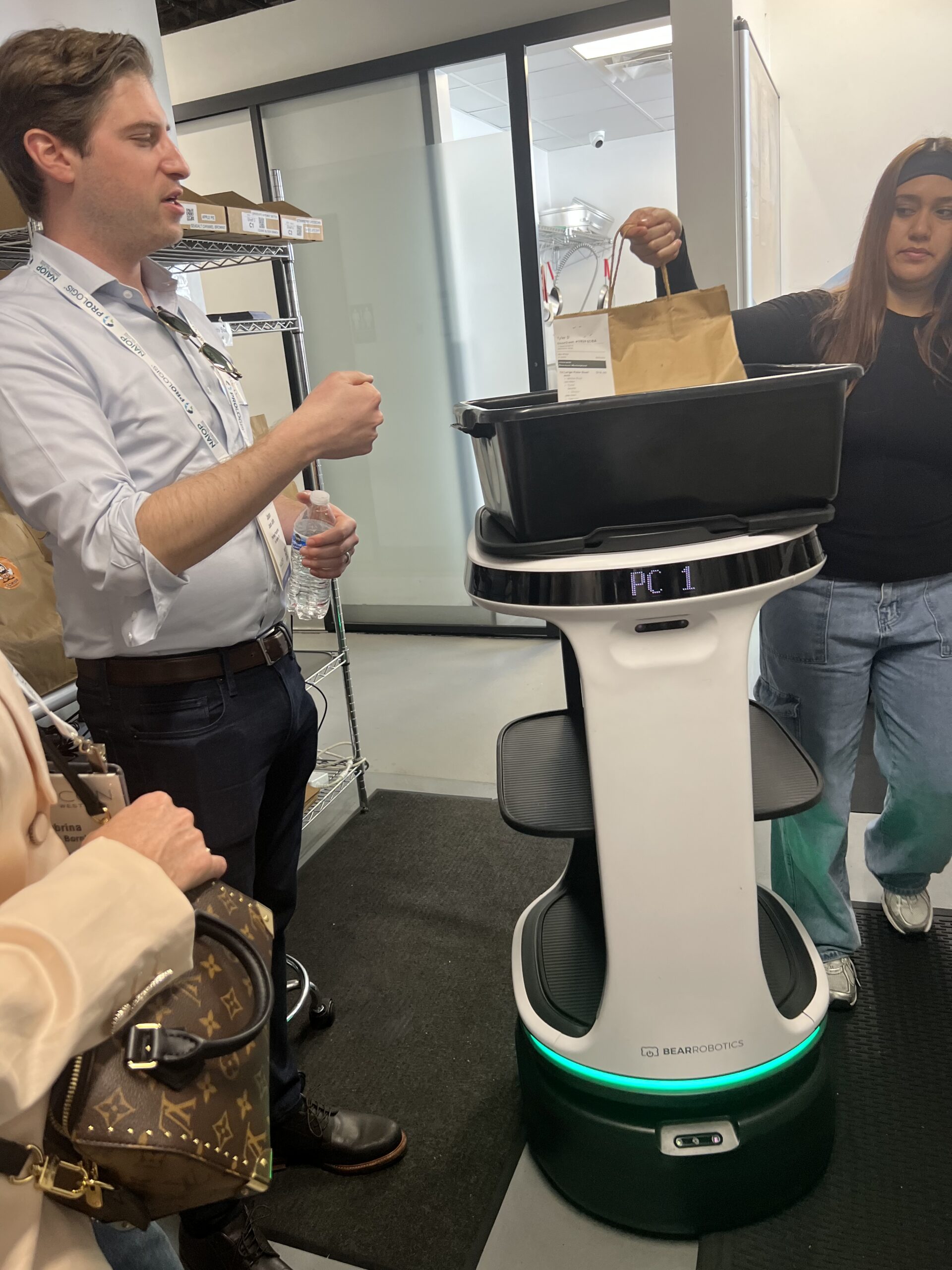
The parking lot tells the story. It’s packed – constantly. Drivers quickly pull into the 5-minute-limit spots, head inside to pick up the order, then depart to deliver it. They never enter the kitchen corridors. Instead, they interact only with the lobby – a carefully designed interface between technology and food, where autonomous hallway robots help transport orders internally from kitchen to “smart lockers.”
Early on, the company identified a major operational flaw in the delivery ecosystem: the driver bottleneck.
The solution? Integrated smart lockers tied directly into platforms like Uber Eats and DoorDash.
“Our lockers are tied into their app. Someone walks in, scans their phone, a locker opens, they grab their food, and they’re out,” Jaffe said.
The system reduces congestion and improves driver economics. “They make money when they are delivering food. This limits the amount of time they spend in the parking lot.”
Engineering at Scale and a Custom-built BMS
The true marvel of the building is hidden above ceilings and beneath floors, all necessary to ensure consistent operations for tenants doing everything from brewing coffee, rolling breakfast burritos and assembling poke bowls, among others. Features include:
- 55,000 cubic feet per minute of exhaust capacity
- Over 100 tons of cooling
- 34 electrical panels
- 57 roof penetrations
- Four 250-gallon hydromechanical grease interceptors
- 1,200-amp house power panel
- Three massive indoor makeup air units
Standard building management systems weren’t designed for dense food production, so the company built its own: ProSense, which monitors airflow, exhaust and fresh air intake in real time. Soft-sided ductwork dynamically inflates or contracts based on cooking intensity, automatically balancing airflow.
“There’s never a world in which frying air from one kitchen makes it into another kitchen. Everything is exhausted. The whole building is negative pressure,” said Jaffe.
One of the more innovative engineering choices involved grease interception. Instead of installing a massive underground 3,000-gallon interceptor in the parking lot – which would have required ejection pumps due to grade differences – the team installed four hydro-mechanical interceptors inside the building.
Faster Tenant Turnover, Fewer Permits
Traditional restaurant buildouts are slow and permit heavy. This model changes that.
“In a traditional building, you need multiple permits,” Jaffe explained. “Health, building, facility, personal licensing. Here, you just need one.”
When a new tenant signs, move-in can happen within days after a health department inspection. Each kitchen comes standard with a three-compartment sink; a handwashing sink; a 9-foot exhaust hood; and gas, power and plumbing connections.
Tenant mix is strategic. In this facility, 40% of the square footage houses national operators like Starbucks. But there’s a critical blend: national brands offer lease stability, while local brands provide diversity and can respond to local demand. The average lease term is five years and the facility is 100% leased.
Market Ready
In dense markets like Los Angeles – especially near food hubs like the Ports of Los Angeles and Long Beach – positioning is deliberate. “It’s a super dense market for us,” Jaffe said. “There’s so much demand.”
At first glance, it’s just another building along a busy Los Angeles throughfare. But inside, it’s a vertically integrated engine powering the delivery economy – one order, one locker, one kitchen at a time.

This post is brought to you by JLL, the social media and conference blog sponsor of NAIOP’s I.CON West 2026. Learn more about JLL at www.us.jll.com or www.jll.ca.