Can industrial architecture be creative, contextual and cost-effective at the same time?
Ten years ago, this was the challenge accepted by Steven Harper, AIA, co-founder and managing partner at Modellus Novus, and Mac Carbonell, founder and creative director at Verdant, in their team’s adaptive reuse of the Crye Precision headquarters at the Brooklyn Navy Yard.
At the I.CON East conference this week in Jersey City, New Jersey, the pair demonstrated how constraints – including landmark status, operating costs, horticultural interest and mechanical, electrical and plumbing (MEP) demands – sparked innovation. Disciplined planning, landscape integration and precise logistical coordination transformed a 100,000-square-foot former shipbuilding facility into a modern industrial workplace with a strong sense of identity.
There is a growing trend among clients who want to live their brand and create a “feeling” in their workspaces. Harper’s experience with this at Modellus Novus started with Crye Precision. The textile manufacturer’s founder wanted to create a distinctive space that would serve as a manufacturing, design, and client-facing workspace for the company. Starting with a 1900s ship-building structure in poor condition, the team’s mantra was, “Don’t mess it up.” The challenge was how to incorporate a 21st-century building without losing the original character.
The client had previously leased several spaces across different areas of the Brooklyn Navy Yard. Harper gained a deep understanding of Crye Precision’s operations and created a design to maximize the flow of their process, from raw materials to finished products. This included a first floor to deliver raw materials to manufacturing, a mezzanine level for design and expansion, and an MEP structure built behind the current building. Harper pointed out that this kept the space open to air and light and was cost-efficient.
They installed many sliding doors to accommodate employees’ rolling carts, and because the client needed to retool their sewing rooms for each customer’s order, tables were designed to be flexible, and compressor lines dropped down from the ceiling.
They also painted two yellow lines across the floor space, “as a call back to the train tracks that ran through the space previously,” and to achieve historical building tax credits.
With the client’s needs met, Harper was able to focus on a design element to add distinction. He tapped Carbonell’s firm to handle horticulture.
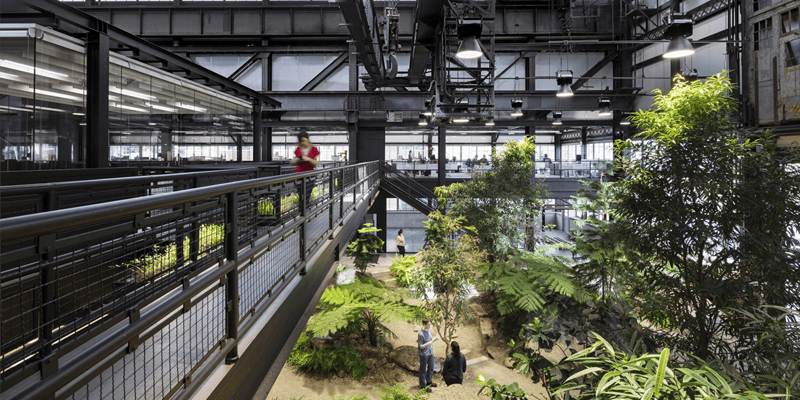
“What was exciting about this project horticulturally was that the client wanted to push [the limits],” said Carbonell. Challenges included getting the height and lighting right for trees in the building. First, they conducted a preliminary study, which led to the introduction of stadium lighting 25 feet above the ground to support plants. They also built a mini model with plants in a room for six months to make sure they didn’t live out a horticulture design firm’s biggest fear – that the plants would die.
The Navy yard is built on landfill; they tested the ground for contaminants, excavated, poured a foot of gravel (and deeper for trees), and brought in new soil.
The plant life chosen was a broad selection of mostly tropical plants that thrived in 60-80-degree temperatures. To flourish, they had the client agree that they would not leave their front bay doors open. And finally, to deal with pests, especially rats, which are common to the shipyard, the client got a cat.
The forest is meant to be seasonal, with leaves falling in autumn and plants flourishing in spring. Carbonell hired a gardener who maintains the forest and installed an irrigation and misting system. With a client budget of approximately $40,000 per year, the building’s horticultural elements have flourished over the last decade.
The forest is a “wow” factor when clients come to the building, beginning with a walk through the forest to reach a concrete reception desk. Clients are welcomed and then ascend to the second floor via elevator or stairs, which are a catwalk among the tall trees. Harper’s team built an island conference room – a minimal glass box set above and between the forest and the production side of the building.
The building was completed on time and under budget, and it won a 2020 AIA New York Design Award. The project itself came in at about $140 a square foot in 2016 dollars, and the horticulture element was in the single digits as a percentage of the overall construction budget.
“I think that they feel like it was a really worthwhile investment just to add a couple of percentage points onto the total, to have something really sort of remarkable and differentiating both for their team and for their guests,” Harper concluded. He added that employee retention at Crye has been incredible.

This post is brought to you by JLL, the social media and conference blog sponsor of NAIOP’s I.CON East 2026. Learn more about JLL at www.us.jll.com or www.jll.ca.