
Digitally fluent, socially connected and budget-conscious, Generation Z is entering the residential market with growing momentum. Over just five years, young renter households skyrocketed from 700,000 to 4.4 million, a sixfold expansion redrawing the map of demand from Birmingham, Alabama, to San Jose, California.
Although the vast majority of twentysomethings continue to rent rather than own, the pace at which young buyers are acquiring property is accelerating even faster – despite representing fewer than 1 million households overall. In fact, only 17% of Gen Zers own a home so far.
A RentCafe analysis of 97 U.S. metropolitan areas – each with at least 15,000 Gen Z households – reveals where the youngest generation of renters and buyers is choosing to live and which markets are recording the sharpest gains.
SUN BELT METROS SURGE AHEAD IN YOUNG RENTER GROWTH WHILE COASTAL HUBS HOLD FIRM
Today’s young renters are looking for cities with employment prospects, healthy wage gains and plenty of outdoor and entertainment options for a balanced lifestyle. But opportunity no longer resides exclusively in expensive coastal corridors. Emerging youth hubs across the South are absorbing much of the demand.
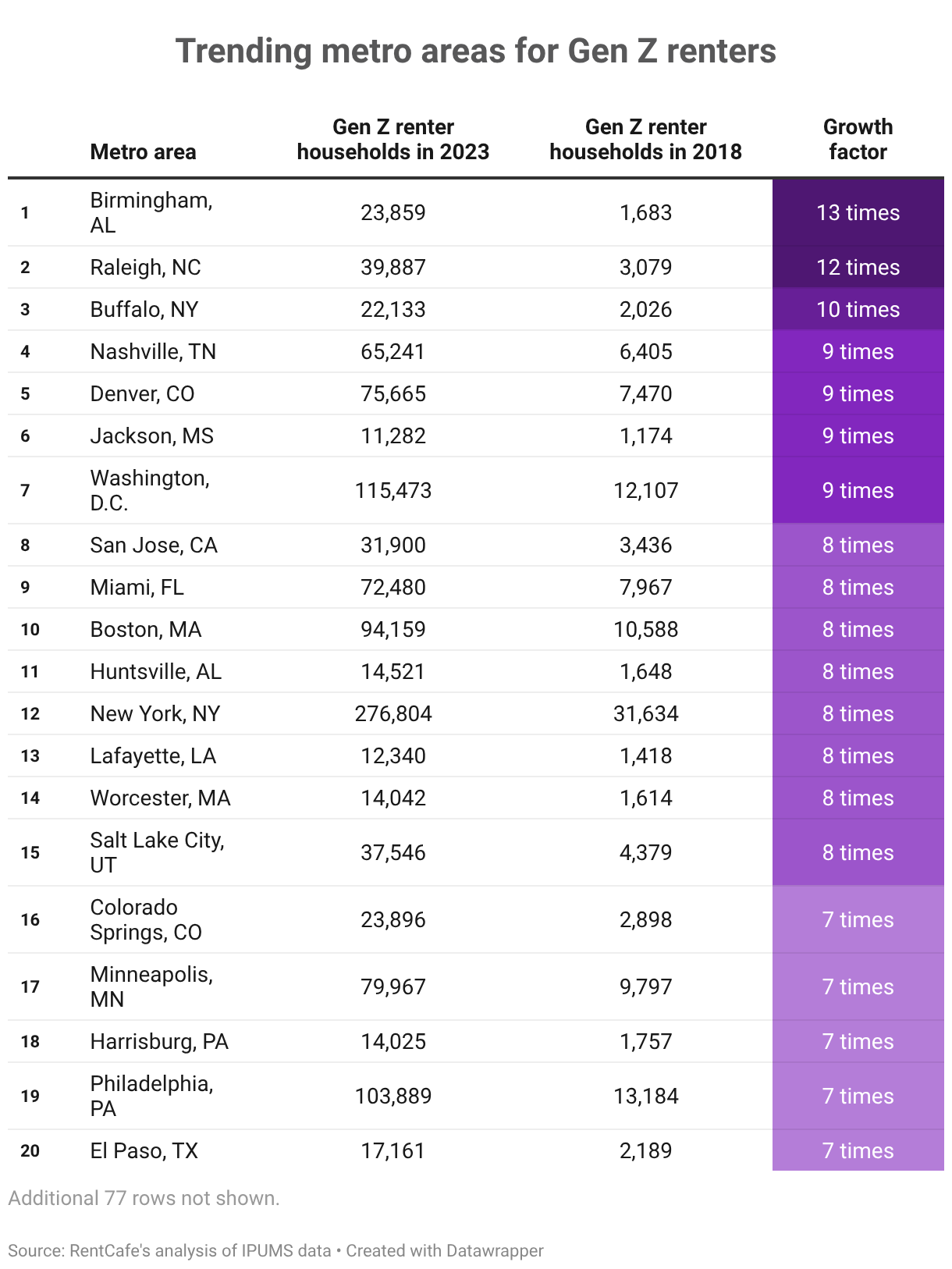
Birmingham, Alabama, exemplifies this shift. Five years ago, the metro barely registered on any Gen Z radar; today it leads the nation in young renter growth with a thirteenfold increase – from 1,683 households in 2018 to 23,859 in 2023. A lower cost of living (9% below the national average), expanding business activity, and diverse entertainment options draw young renters to Alabama’s largest metro.
Huntsville, Alabama, reinforces Alabama’s popularity among Gen Zers, ranking 11th after an eightfold increase.
Raleigh, North Carolina, ranks second with a twelvefold jump (3,079 to 39,887). The metro area’s appeal rests on its emergence as a tech hub and a 299% income gain in five years. Here, nine of 10 Gen Zers rent.
Buffalo, New York, climbed to third via affordability and remote-work appeal. Nashville, Tennessee, is fourth on the list after a ninefold surge that led to more than 65,000 Gen Z renter households in the metro area. Denver, in fifth place, posted a comparable ninefold gain driven by outdoor access and activities, and a strong job market.
Jackson, Mississippi, and Lafayette, Louisiana, round out the Southern contenders as affordable alternatives to coastal metros.
MAJOR METRO AREAS REMAIN POWERFUL DRAWS FOR GEN Z RENTERS
Large gateway cities continue to attract significant Gen Z renter volume. Washington, D.C., ranks seventh with nine times more young renter households in 2023 than in 2018 – reaching 115,473. The capital’s government, policy, technology and consulting sectors, combined with a tripling of typical young-professional income, sustain its pull.
San Jose, California, holds the eighth growth spot while claiming the highest renter share – nearly 95%. Miami follows at ninth and Boston at 10th, each posting eightfold increases.
New York ranks 12th and commands the largest absolute count at close to 280,000 Gen Z renter households after an eightfold expansion. New York City’s appeal is fueled by unmatched opportunities, experiences and networking, but also the quadrupling of Gen Z’s average income. Minneapolis and Philadelphia each recorded sevenfold gains; across all three metros, eight of every 10 Gen Zers rent.
CALIFORNIA AND TEXAS MARKETS REGISTER THE DENSEST YOUNG RENTER POPULATIONS
San Jose tops the concentration rankings with 95% of Gen Zers in the renter category. Four additional California metros feature in the top 20: San Francisco at 92%, Los Angeles at roughly 91%, San Diego at 91%, and Sacramento, California, at about 88%. Despite paychecks tripling in five years, elevated home prices keep ownership out of reach, reinforcing renter density.
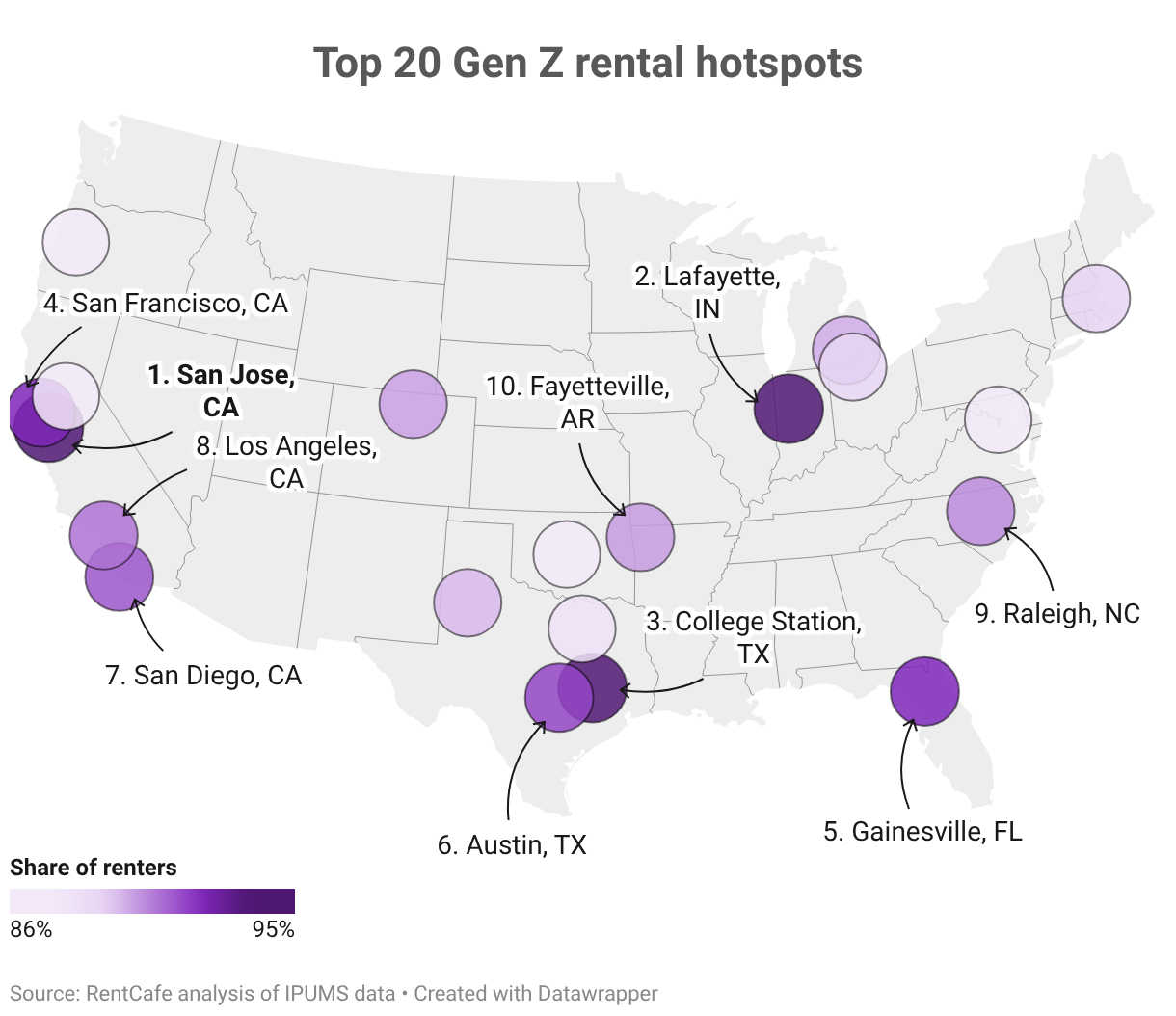
Texas contributes four metros as well. College Station, Texas, places third at 93%, driven by Texas A&M University’s enrollment expansion. Austin, Texas, ranks sixth at approximately 92%. College-town Lafayette, Indiana, is the runner-up at 94%, while Raleigh and Ann Arbor, Michigan, each show nine of 10 Gen Z households renting.
AFFORDABLE HEARTLAND AND MID-SIZED MARKETS CAPTURE FIRST-TIME GEN Z BUYERS
Lower mortgage rates between 2020 and 2022 triggered the first substantial wave of Gen Z home purchases, concentrated in smaller and mid-sized metros across the South and Midwest where affordable prices coincide with strong income gains.
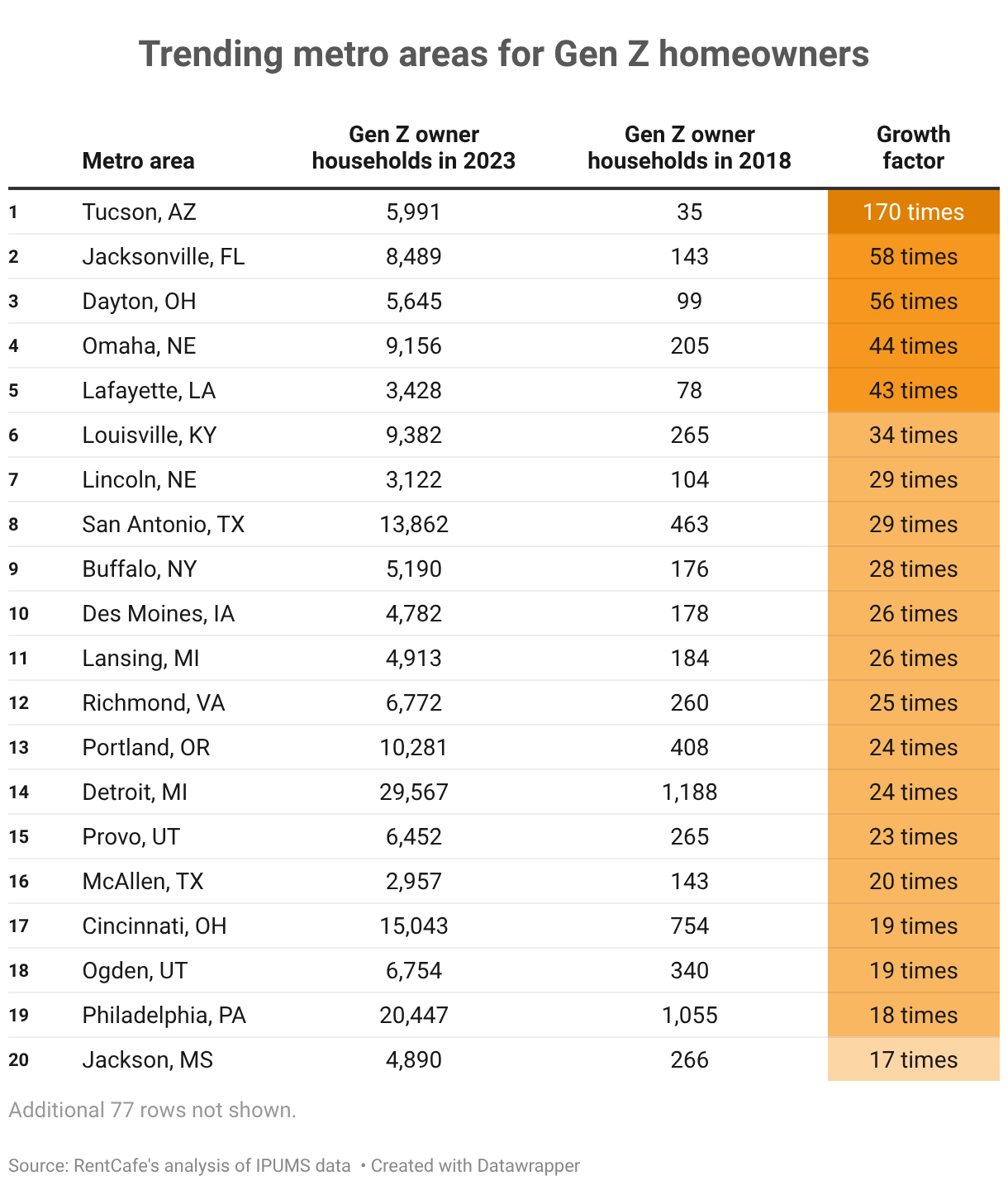
Tucson, Arizona, leads by a wide margin: Owner-occupied Gen Z households surged 170-fold, from 35 in 2018 to roughly 6,000 in 2023 – aided by the University of Arizona’s presence and a market far less expensive than Phoenix. Jacksonville, Florida and Dayton, Ohio, follow with approximately 60-fold jumps; both offer below-average living costs and solid wage growth.
Omaha, Nebraska, recorded a 44-fold increase to exceed 9,000 households, buoyed by housing costs roughly 20% under the national benchmark. Lafayette, Louisiana, ranks fifth with more than 3,400 homeowners in 2023 versus 78 in 2018 – 22% of all young-adult households. Louisville, Kentucky; Lincoln, Nebraska; San Antonio, Texas; Des Moines, Iowa; Lansing, Michigan; and Buffalo, New York – the highest-ranking Northeastern metro – also posted rapid gains.
WHICH MARKETS HOLD THE GREATEST CONCENTRATION OF GEN Z HOMEOWNERS?
Among the 97 metros studied, 10 have more than one-quarter of Gen Zers owning a home. Ogden, Utah, leads at approximately 41%, aided by proximity to Salt Lake City and local homeownership assistance programs. Detroit follows with one-third of young adults owning homes after household counts surpassed 29,500. Birmingham, Alabama, and Jackson, Mississippi, each register 30%, propelled by incomes that more than tripled. Greenville, South Carolina, ranks next at about 28%.
At the opposite extreme, San Jose, California, has the smallest Gen Z homeowner share at just 5% – underscoring how affordability constraints and a preference for flexibility keep nearly all young residents in the rental market.
For more insights, charts, and a detailed methodology, read the full report on RentCafe.com.