By Brielle Scott
Artificial intelligence is transforming the industrial real estate landscape in profound and sometimes paradoxical ways. As AI technologies become more embedded in logistics, fulfillment and manufacturing, they influence both the demand for warehouse space and the nature of the workforce inside these facilities.
A new report by the NAIOP Research Foundation, “From Static to Strategic: AI’s Role in Next-Generation Industrial Real Estate,” examines how AI is affecting industrial building development and shaping the systems within these buildings.
AI’s impact on warehouse demand is multifaceted. On one hand, it fuels e-commerce growth through personalized recommendations, dynamic pricing and automated marketing, driving increased demand for storage and fulfillment space. On the other hand, AI also enables more accurate sales forecasting and space optimization, allowing companies to do more with less. Some businesses are already reporting significant reductions in the amount of space needed to maintain service levels, thanks to smarter inventory management and automation.
This means that while overall square footage demand may fluctuate, the value of warehouse space is rising. More productive, AI-enabled facilities are commanding higher rents, as occupiers are willing to pay a premium for efficiency, speed and reliability.
AI is also giving rise to entirely new types of industrial buildings. Hyperlocal delivery models, powered by AI logistics optimization, are driving the growth of micro-fulfillment centers – smaller warehouses located closer to consumers in urban areas. These facilities prioritize speed and proximity over scale, reshaping the traditional distribution model.
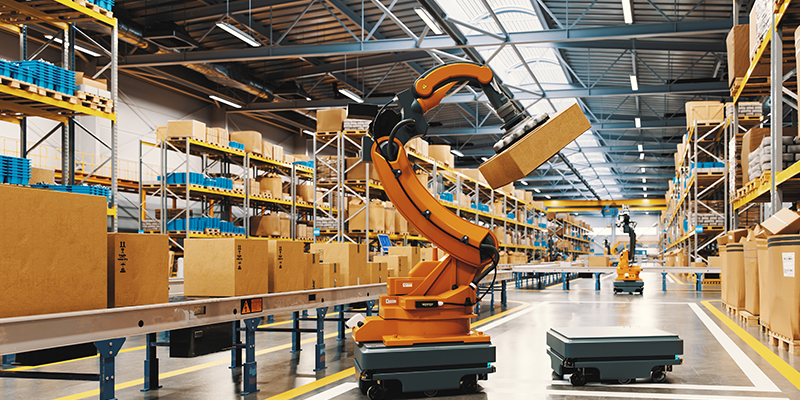
Meanwhile, companies like Aibuild are pioneering the concept of smart, sustainable manufacturing hubs that combine on-demand 3D printing, robotic fulfillment, and AI-driven operations. Global giants such as Tesla and Foxconn are investing heavily in this vision, which could reduce the need for traditional inventory storage altogether. In this future, manufacturing and fulfillment may happen simultaneously within buildings that once served solely as warehouses.
AI is not just changing where and how goods are stored – it’s also transforming who works in warehouses and what they do. Manual pick-and-pack roles are increasingly being replaced or augmented by automation, while new positions in reliability, maintenance and engineering are emerging. According to Amazon’s Stefano Perego, AI allows companies to “reallocate people to higher value-added activities,” freeing workers from repetitive tasks and enabling them to focus on roles that require analytical thinking and decision-making.
Tools like Butterfly AI and Kargo AI are empowering employees with real-time feedback and automated dock operations, respectively – distributing strategic information and improving operational transparency across the enterprise.
At the organizational level, AI is becoming a core driver of business strategy. Prologis, a global leader in logistics real estate, has embraced AI across its operations, developing over 25 enterprise-level language models and seeing widespread adoption among its workforce. The goal: shift employee focus from data compilation to strategic thinking and faster decision making.
Looking ahead, the convergence of AI, robotics and automation is setting the stage for a new generation of intelligent industrial facilities. From SoftBank’s proposed $1 trillion investment in AI-powered industrial parks to Xiaomi’s self-optimizing “dark” factory in Beijing, the future is being built today.
Imagine a world where buildings themselves become intelligent agents – capable of interacting with occupants, optimizing performance and adapting to changing conditions in real time. Warehouses are no longer passive storage spaces; they are becoming dynamic, responsive hubs at the heart of the digital economy.