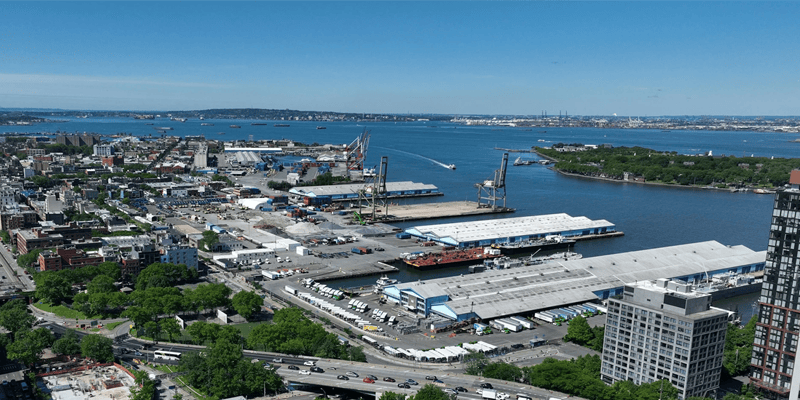
At I.CON East this week, tour attendees got an up-close look at how the New York City Economic Development Corporation (NYCEDC) plans to modernize the Brooklyn Marine Terminal (BMT), transforming it into a key component of the city’s “Harbor of the Future,” while also addressing a critical land-based concern: more housing at a range of affordability levels.
NYCEDC assumed operational control of the 122-acre site in 2024 from the Port Authority of New York and New Jersey. The Port of New York and New Jersey, comprising multiple sites, is the nation’s second busiest port for loaded containers, but BMT serves a small niche segment of the market, handling under 1.5% of container volume. David Lowin, senior vice president of development in NYCEDC’s asset management group, said that while BMT no longer fit into the Port Authority’s long-term plans, it offered a “generational opportunity” for the city.
He explained that BMT is something of an outlier from other terminals in the area. For one, it is the only such facility east of Manhattan. For another, it is surrounded by a residential neighborhood (Red Hook) and doesn’t have any connection to rail. Much of the acreage is not intensely used, and only 51% is occupied by maritime-dependent uses: the Brooklyn Cruise Terminal and the Red Hook Container Terminal. Its existing finger piers are either out of service or nearing the end of their useful life.
Still, Lowin emphasized that the vision for BMT is not to displace its maritime uses, but rather to reinvest in them while dedicating its unused land to residential and mixed-use assets.
Among the goals he highlighted for BMT were:
- Reinvesting in the port, including addressing a significant amount of deferred maintenance and supporting its long-term financial sustainability.
- Modernizing and electrifying the port while decreasing its use of diesel.
- Maximizing the number of containers entering and leaving the port via water while reducing truck traffic on the surrounding streets.
- Taking advantage of unused land to create mixed uses such as hospitality, retail and light industry that benefit the community.
- Increasing the density of the site so that ferry service can increase from once per hour to three times per hour.
- Improving resiliency by preparing the site and adjoining neighborhoods for sea-level rise and climate change.
Another major component of the new vision for BMT is the creation of 6,000 housing units, including 2,400 affordable units, across two separate sites that are currently partially vacant or underused: Atlantic Basin and BMT North.
“This is one of the few opportunities that still exist in the city for creating housing at scale,” Lowin said. The mixed-use residential development will also create open space and public waterfront access.
Plans are to transform Atlantic Basin into a newly activated and modern working waterfront. Preliminary concepts include enhanced ferry service, a new cruise terminal, and a workforce training and experiential learning center. BMT North is envisioned as a pedestrian-forward neighborhood with transit focused on Columbia Street, including a dedicated neighborhood busway.
Other planned uses include 250,000 square feet of community facility space, 275,000 square feet of commercial space, 275,000 square feet of light industrial/industrial space, and up to 400 hotel rooms.
BMT is also envisioned as the entry point into a broader “Blue Highways” freight system. Under this plan, food-grade containers would come into BMT on container vessels from international ports and then be transferred onto barges for delivery to a large food distribution center at Hunts Point in the South Bronx, greatly reducing emissions and traffic from truck deliveries. According to NYCEDC, there are opportunities for Blue Highways activities at more than 25 locations along the city’s waterfront. It is also exploring the potential use of private landing sites in partnership with industry along the Bronx and Queens waterfronts.
According to figures from NYCEDC, the new vision for BMT is expected to generate $18 billion in economic impact. In addition, it is expected to create 37,000 temporary construction jobs and 2,000 permanent operational jobs.
While leading tour attendees on a van tour of BMT, Lowin noted that the site is currently limited by its infrastructure. But that is changing. Currently, $418 million of public capital has been secured from a combination of city, state and federal funds to revitalize and modernize the container port. The future 60-acre port will feature flex maritime space, including additional container storage, bulk cargo, construction staging and Blue Highway space.
The goal: to set a new standard for modern maritime.
This post is brought to you by JLL, the social media and conference blog sponsor of NAIOP’s I.CON East 2026. Learn more about JLL at www.us.jll.com or www.jll.ca.