To ensure commercial real estate developers can build the communities of our future, all levels of government must ensure proper maintenance of and investment into transportation infrastructure. Whether in the form of highways, roads, freight rail, ports or public transit, transportation infrastructure helps regions meet their economic potential. A lack of coordination between the levels of government and internationally poses a threat to major infrastructure projects, which require years of planning and stability to complete. However, recent regional success stories provide reasons to be optimistic about the future of transportation infrastructure. Going forward, state and local governments have the opportunity to follow their lead. As for the federal government, one of NAIOP’s three federal priorities for 2026 is for Congress to pass a multiyear authorization of surface transportation programs before they expire on Sept. 30.
One high-profile instance of disruption to a vital transportation infrastructure project is the standing of the Gateway Hudson Tunnel project since October 2025. This project began in 2011 with the goal of building a new tunnel for rail on the Northeast Corridor line between New Jersey and Manhattan to replace the century-old North Tunnel. When Hurricane Sandy severely damaged the North Tunnel the following year, the need for the Gateway Hudson Tunnel intensified. By 2023, the federal government had committed $12 billion of the project’s estimated $16 billion price tag, largely through the bipartisan Infrastructure Investment and Jobs Act, and construction began.
However, when the longest government shutdown in history began in October 2025, the Office of Management and Budget immediately withheld all federal funding for the project. Funding remained frozen when the government returned in November, causing construction to halt on Feb. 5. Leaders from NAIOP’s New York City Metro and New Jersey chapters, along with other CRE industry leaders, signed onto a letter to the Trump administration requesting funds be released immediately. The Northeast Corridor supports 20% of national GDP, while the current dilapidated tunnel carries 200,000 commuters every day, making this project vitally important for economic development in the region. Thankfully, a judge ordered the funds unfrozen a day after construction stopped, and an appeals court rejected the administration’s emergency stay, resulting in the disbursement of $30 million on Feb. 14. Still, court cases are ongoing, resulting in uncertainty over billions of dollars of funding for a vital, decades-long project.
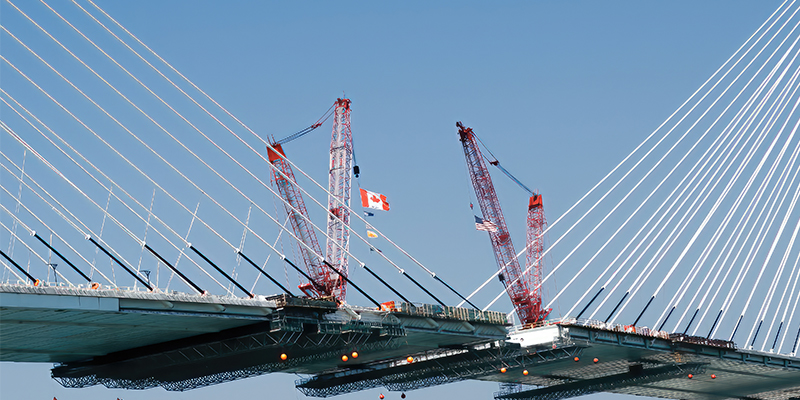
Another major transportation infrastructure project put in jeopardy earlier this year was the Gordie Howe International Bridge, crossing the Detroit River to connect Detroit, Michigan, and Windsor, Ontario. This time, however, the threat affected a project that had already been completed. Planning for the bridge began in 2012 as an alternative to the Ambassador Bridge, with Canada providing financing and ultimate ownership to be split jointly between the governments of Canada and Michigan. Construction began in 2018 and had largely finished by February 2026, with plans to open this year. On Feb. 8, the Trump administration publicly threatened that it would prevent the bridge from opening as part of its ongoing trade dispute with Canada. Though Prime Minister Mark Carney has expressed confidence that the dispute will be resolved, every week of delay would cause up to $7 million in costs. This kind of uncertainty at the end of a decades-long multi-billion-dollar infrastructure project could discourage investment in the future.
While these large, federally funded projects get much attention, many of the opportunities for successful transportation funding lie at the local level. Additionally, the local level is where NAIOP chapters can most effectively make their voices heard. Last year, NAIOP Charlotte played a pivotal role in the successful campaign to pass a ballot proposition in Mecklenburg County that will generate $20 billion for transportation infrastructure investment over the next 30 years. You can read more about this success here. Similarly, NAIOP’s Gulf Coast chapter took a strongly supportive position on a ballot proposition in 2025 that would allow the city to issue bonds generating $415 million to improve streets, bridges, buildings, parks, equipment and more. It passed with 77% support from voters.
All levels of government have work to do to ensure proper infrastructure investment and maintenance. As uncertainty grows and state and local governments face budget shortfalls, NAIOP must advocate for transportation infrastructure policies that facilitate economic growth and commercial real estate development.