Automation has been quietly reshaping industrial buildings for years – conveyors, sortation, AS/RS, robotics – but AI still feels like the new kid in the warehouse. In a panel discussion at NAIOP’s I.CON West this week in Los Angeles, moderator Luke Corsbie, principal at Ware Malcomb, spoke with David “DJ” Ikeda, regional manager for Bastian Solutions, an automated logistics company focused on automation and facility design; Rohan a’Beckett, vice president, Brookfield Properties; and Dana Miarmi, senior vice president – national industrial lead, JLL.
Corsbie set the tone early: adoption of artificial intelligence (AI) is a game changer, but the industry is still “in an early discovery period.” The winners will be the teams that learn how to use it responsibly, not blindly.
The discussion brought together perspectives from development, automation design and portfolio operations, and landed on a few practical truths: AI is only as useful as the data you feed it; automation-ready buildings are raising the bar for class A; and power and site constraints are now inseparable from “feasibility.”
AI IS HERE – BUT “GARBAGE IN, GARBAGE OUT” IS STILL THE RULE
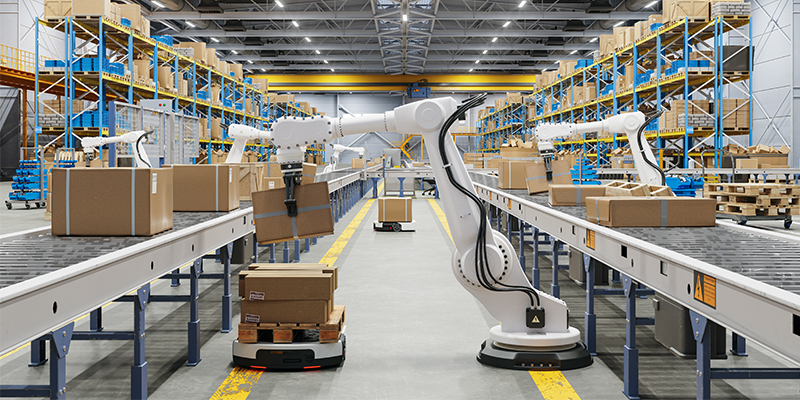
Asked about the technologies being used today, Ikeda drew a clear distinction between automation and AI. Automation is the physical layer – systems, robots, vehicles – while AI is increasingly the decision layer.
On the automation side, he pointed to “automated guided vehicles,” while AI is showing up more in data collection and data analysis. But he emphasized that most teams are still using AI as an assistant, not an authority: “It is still taking a lot of effort to make sure it’s steering in the right direction.”
The biggest surprise? Many clients assume AI can magically clean up bad data. Ikeda continues, “They have some crazy idea that we can have a mess of information and that AI can make it pretty. However, the AI is very much dependent on clean input. If the input is a mess, you’re just going to get a mess out of it.”
Miarmi echoed the sentiment: “Most people don’t realize that it is about the clarity of the data going in. If you don’t have clean data, you won’t get accurate analysis. Your decisions can be greatly affected.”
AI won’t replace operational thinking – it will amplify it. Or as Miarmi put it, “You are still the innovator. Let AI do the validation.”
THE HUMAN FACTOR: FEAR, LEARNING CURVES AND TEAM “AI REPS”
The panel didn’t sugarcoat adoption anxiety. Many people are worried that AI will take over their job. Corsbie acknowledged that intimidation is part of the resistance: “It’s new, not very well known, and you need practice.” He shared a simple tactic that’s easy to steal: In weekly calls, his team makes time for quick, “How did you use AI?” conversations – what worked, what failed, and what people learned. That kind of internal peer learning can flatten the learning curve faster than any policy memo and reduce both resistance and anxiety.
Ikeda added another practical reminder: “just trying it out” matters. Build comfort with the interface and the back-and-forth, iteratively, and then expand.
“AUTOMATION READY” IS CHANGING WHAT CLASS A MEANS
From the development side, a’Beckett made a point that hit home for anyone underwriting industrial today: AI may not dominate day-to-day office workflows yet, but it is influencing building design in a major way.
The big spec shift he described wasn’t futuristic – it was physical:
- Clear height: For larger-format buildings (500,000 square feet and above), “we’re really trying to hit that 42-foot clear height, which allows for the maximum utilization of your automation facility.”
- Flatness: “You also really have to deliver a super flat slab… it’s absolutely critical.”
- Trailer capacity: If automation increases throughput, exterior logistics must keep up. a’Beckett said excess yard/trailer parking is becoming essential – even if it means giving up rentable area: “I’ll sacrifice 200,000 square feet to allow for land for trailer [parking].” He cited the need for “five, six or seven hundred trailer stalls” around a roughly 1.2 million-square-foot building as “vital.”
Ikeda confirmed that the building “outside the box” can become a bottleneck. In older properties, retrofitting for automation often collides with clear height, flatness and infrastructure – and sometimes the upgrade costs kill the deal: “The amount of money to make this automation ready is going to tear your ROI out of it. He offered a blunt threshold: “Anything under 30 feet causes you to cut most automation potential. Forty-two feet is preferred.”
POWER AND SITE SELECTION: FEASIBILITY NOW STARTS WITH INFRASTRUCTURE
When the conversation moved to site selection and feasibility, power took center stage. a’Beckett called power and infrastructure “forefront considerations” and tied power directly to whether a project can deliver a “best-in-class floor.” Ikeda reinforced the point with a real-world example: A client bought adjacent buildings expecting a tall storage system but grading and power became long-term roadblocks.
GEOSPATIAL AUTOMATION AND FASTER SITE PLANS
Corsbie shared one of the most concrete “AI-in-practice” examples of the session – and it wasn’t a flashy chatbot. It was workflow speed. His team at Ware Malcomb has built geospatial-driven tools that pull boundary lines, easements, topography, setbacks and floodplain data “almost instantly,” which help automate early site planning iterations. The impact: something that used to take three to four days can become a much shorter process (24 hours) – with human validation and refinement at the end.
WHERE AI SHOULDN’T GO (YET): SAFETY, LIABILITY AND LEGAL JUDGMENT
When asked what should never be automated, the panel united around safety and liability. One speaker cautioned against letting AI make safety decisions as the “end-all.” Ikeda agreed that for life-safety and code-driven decisions, “it’s really on the person.” a’Beckett added that legal transaction work is still “in our control” – even if many would happily automate pieces of it someday.
Three Takeaways
- Clean data isn’t optional. AI won’t rescue disorder – it scales it. Get your inputs, models and governance right before expecting meaningful outputs.
- Class A is becoming automation ready by default. Expect continued pressure toward 42-foot clear heights, flatter slabs and more yard/trailer capacity – even when it costs rentable square footage.
- Feasibility starts with infrastructure. Power availability and site constraints (grading, connectivity, jurisdictional hurdles) are now make-or-break variables for both new development and retrofits.
The panel closed with realistic optimism: AI is a tool right now, but it’s also a force that will reshape industrial design, construction and operations. The near-term path forward was framed as disciplined experimentation: try it, validate it, improve the data – and keep humans accountable where the stakes are highest.

This post is brought to you by JLL, the social media and conference blog sponsor of NAIOP’s I.CON West 2026. Learn more about JLL at www.us.jll.com or www.jll.ca.