
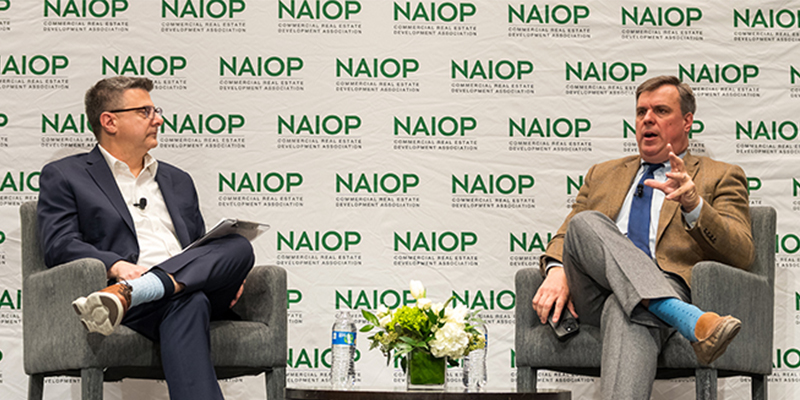
“I think all of us know that we’re living through extraordinary times,” said Jonathan Martin, POLITICO’s bureau chief and senior political columnist. “And it’s just a fire hose for those of us who are living this.” Martin presented the keynote address this week at NAIOP’s Chapter Leadership and Legislative Retreat in Washington, D.C., drawing from his wealth of experience as a political journalist providing coverage from the corridors of power in Washington, D.C., to the campaign trails across America.
Martin identified two key innovations that have reshaped traditional politics, and life more broadly, in the past 20 years: the advent of smart phones and the rise of social media platforms like Facebook, Instagram and others. The combination of a readily accessible computer in our pocket and apps designed to catch and keep our attention – and provide the information we want to hear – have had a profound effect on U.S. elections.
“I don’t think Donald Trump could have existed were it not for this and were it not for the social media apps on this phone,” he said, particularly as the algorithms provide more of the content we want, pushing us into silos of information.
“There’s an old saying that everybody is entitled to their own opinion, but not their own facts, and I think what has happened is that that has been undermined,” Martin said. “We are living through a moment in which politics has become much more nationalized, polarized and divisive.”
Most Americans used to put out lawn signs for their favorite candidate, watch a debate or two, vote in an election and basically move on, Martin noted. Now, politics have become “so tribal and toxic that elections are playing out every day,” whether it’s a Facebook argument with a high school classmate or heated discussions with extended family around the Thanksgiving table.
People ask, “Why can’t they get anything done in D.C.? Why is it so gridlocked?” The answer: The incentive structure for politicians has changed, Martin said. Politicians aren’t trying to cater to the political center anymore. There used to be more of a shared experience of pop culture, national events and media, whether it was watching the same TV shows or listening to popular music on the radio, and both companies and politicians would focus on reaching the broad center of the market.
“Instead of trying to appeal to the center, which you have to win in the general election, 80% of these folks are from House districts in which the elections held in the spring instead of the fall,” he said, “So if you’re a Democrat, you’re catering to the left and trying to keep the left happy, and if you’re a Republican, it’s the same with the right. You’re not thinking about the center because your political fate hangs on the flank, the base of your party, because that’s where primaries are won and lost.”
The Senate is similar, he said, with Senator Susan Collins (R-Maine) standing out as the only senator from a state in which the opposite party has carried the state in the presidential election.
As the incentive culture pushes politicians toward the flanks of their parties, politicians are appealing to their base through being provocative for social media attention, which then garners cable news invites, which then leads to them getting more money.
It’s a much different approach than it used to be: getting to Congress, toiling away, eventually getting on a committee, working across the aisle and maybe, just maybe, getting a bill passed 10 years later, Martin said. “I think that explains a great deal as to why we are where we are.”
“At the same time, the American people have had a loss of faith,” he said. “They see Washington gridlocked, they see things like the Epstein files, and they think they’re all a bunch of crooks.” This cynicism isn’t limited to Capitol Hill, either, but extends to every major institution in America, from the media to churches.
“And that cynicism is the raw material, I think, for folks to come along and stir people up and say, ‘your problems have to do with some scapegoat x, y and z,’ but that’s the period that we’re in,” Martin said. This has made the emergence of Donald Trump possible in a way that would have been difficult in earlier periods, he said, with more gatekeepers in both the media the traditional political parties keeping a political outsider firmly out.
“Now the outsiders are in charge, and the outsiders are now the insiders, and we’re living through the age of Trump,” Martin said. “Politics has now become identity instead of just preference.”
“You’re in Washington in a week in which the government has shut down again for the second time in four months, and now they’re going to reopen. It was brief, but still, the federal government can’t even keep the lights on,” Martin said, referring to the crowd of NAIOP members from across the country who attend the event to share best practices and meet with their legislators on Capitol Hill. “If they can’t keep the government open when they have power all in one party, imagine what it’s going to be like when there’s divided government.”
“I think that’s a way of capturing the context of where we are today; the big picture forces that I think led to this moment that sort of ushered in the Trump era and the Trump presidency.”