
Global capital flows into U.S. industrial real estate are evolving, but one trend remains consistent: Asian investors continue to view the United States as one of the most attractive markets for long-term investment.
That was the central message from a panel at NAIOP’s I.CON West this week in Los Angeles moderated by Garry Weiss, SIOR, vice president – national director business development and strategic initiatives, ARCO/Murray. The panel featured Gunnar Branson, CEO of AFIRE; Richard Prokup, CEO, U.S. logistics, Mapletree Investments; and Cecilia Xu, managing principal, GT Global Advisory.
The speakers explored the motivations behind Asian investment in U.S. industrial real estate, the risks shaping decision-making, and what developers and capital partners should understand as global capital continues to evolve.
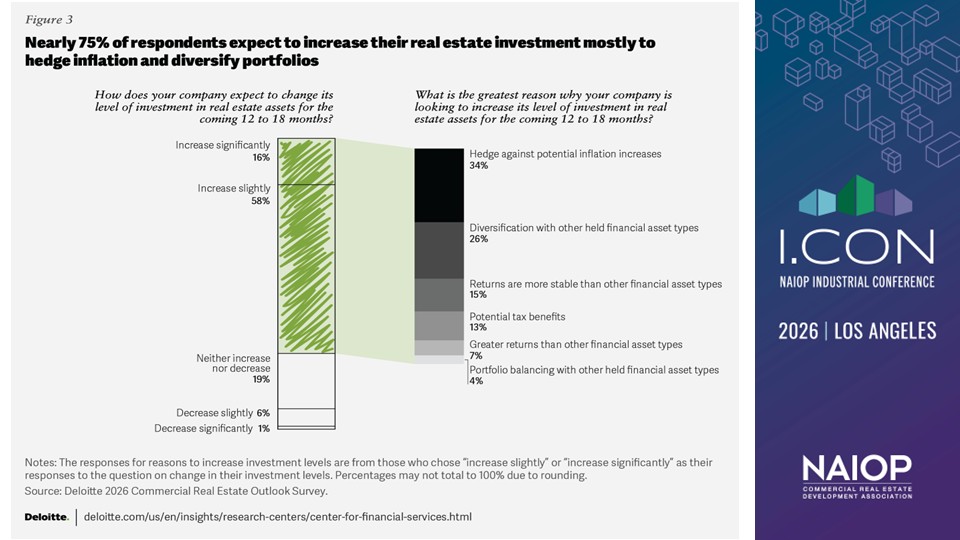
According to Prokup, the current cycle is characterized by a large amount of capital waiting to be deployed after several years of caution. “Everybody was on the sidelines for the last few years,” Prokup said. “There was uncertainty about demand, and uncertainty about the economy and rising interest rates. But these organizations still have billions of dollars they need to place every year.”
Now that market conditions are stabilizing and industrial fundamentals remain strong, capital is beginning to move.
The scale of the U.S. market also makes it difficult for global investors to ignore. “If you want to place capital at scale, the United States is really the only place where you can do that,” Prokup said. “The industrial market here is massive compared with most other regions.” Branson agreed, noting that the U.S. represents roughly half of the world’s investable institutional real estate.
“In most countries, you’re lucky to have one global city,” Branson said. “In the United States, you have about a dozen. That scale is incredibly attractive to global investors.”
GEOPOLITICAL UNCERTAINTY IS NOT SLOWING INVESTMENT
While headlines often focus on political tensions, tariffs and shifting global alliances, panelists said those factors are not deterring investment as much as some might expect.
Instead, geopolitical uncertainty often reinforces the appeal of the U.S. market.
“There’s what people say emotionally about politics, and then there’s what they actually do with their capital,” Branson said. “Those two things are often very different.” According to Branson, investors may voice concerns about political volatility, but they continue to view the U.S. as a relatively safe environment for long-term real estate investment.
Xu added that global trade tensions can even strengthen the case for U.S. industrial development. “If companies are worried about tariffs or supply chain disruptions, one way to reduce that risk is to move operations into the United States,” she said. “That means more demand for logistics and manufacturing space.”
Prokup said that Singapore-based global real estate developer, investor and manager Mapletree has already seen that shift in tenant demand. “About half of the major leases we signed last year involved companies bringing manufacturing or distribution back onshore.”
DEVELOPMENT OPPORTUNITIES ARE EMERGING
Prokup also pointed to a significant opportunity that emerged during the past year as construction pipelines declined across many markets. As new development slowed, Mapletree began building a new pipeline of projects.
“The pipeline under construction kept shrinking,” Prokup said. “At the same time, demand was still there. We started asking where the new buildings would come from in 2026 and 2027.”
In response, the firm moved aggressively into development.
“We’ve built about a half-billion-dollar development pipeline over the last year,” Prokup said. “We saw a window where there simply weren’t many competitors pursuing new projects.”
However, he noted that development activity is beginning to pick up again as other investors recognize the same opportunity.
PARTNERSHIP REMAINS KEY TO ATTRACTING GLOBAL CAPITAL
For developers and operators looking to work with Asian capital, panelists emphasized the importance of building long-term relationships rather than focusing on individual transactions.
Xu explained that relationship-building is particularly important for many Asian investors. “The first deal is always the hardest,” Xu said. “There is a long process of building trust and completing due diligence. But once that relationship is established, you often gain a very loyal capital partner.”
Those relationships frequently lead to multiple investments across different market cycles. “It’s not just about one deal,” Xu said. “It’s about working together over time.”
Branson also cautioned that “Asian capital” should not be viewed as a single group. “Asia is half the world,” he said. “There are many different countries, cultures and investment strategies involved.”
Understanding those differences can help developers build stronger partnerships and attract long-term capital.
A CHANGING GLOBAL INVESTMENT LANDSCAPE
Looking ahead, panelists expect the mix of international investors in U.S. real estate to continue evolving.
Branson noted that capital activity from countries such as Australia and Japan is increasing in the U.S. market. “They have enormous pension systems and limited opportunities to deploy capital domestically,” Branson said. “That’s pushing them to look abroad.”
Over time, Xu expects Asian investors to become even more integrated into the U.S. real estate landscape. “In five years, Asian capital will feel much less ‘foreign,’” she said. “Many of these investors have already been active in the U.S. for decades.”
As global capital continues to flow toward stable, large-scale markets, panelists agreed that U.S. industrial real estate is likely to remain a primary destination. “The fundamentals are still very strong,” Prokup said. “And when investors look around the world, the U.S. continues to stand out.”
This post is brought to you by JLL, the social media and conference blog sponsor of NAIOP’s I.CON West 2026. Learn more about JLL at www.us.jll.com or www.jll.ca.